


Page 12 - A9Rc19d2z_zddyc4_fc0.tmp
P. 12
Our Research:


                             Health Behaviour


                             Theme Leader: Professor Paul McNamee


                            The Health Behaviour theme     At the end of the year Patrícia Norwood and Paul
                            aims to enhance understanding   McNamee began a new Scottish Government funded
                            of health behaviour (principally   project, in collaboration with Scotland’s Rural College,
                            alcohol consumption, physical   assessing the importance of prices and promotion on
                            activity and dietary choice) from   discretionary foods (i.e. snacks such as crisps, biscuits
                            an economics perspective, and   and chocolate confectionary, as well as ice cream,
                            to strengthen the evidence-base   puddings and sugar-sweetened beverages). The
            Paul McNamee
                            relating to interventions that aim   project uses existing data from the Kantar World Panel
            Theme Leader
                            to influence behaviour, both in   and is also collecting new primary data on consumer
            terms of their design and in terms of evaluation of their   preferences, using discrete choice experiments, to
            effect on costs and outcomes. We also consider wider   inform future Scottish Government policy on the
            determinants of health besides health behaviour, such   impact of restricting the promotion and marketing of
            as education and working conditions.           discretionary foods high in fat, sugar and salt.
                                                           Research undertaken by Marjon van der Pol into time
                                                           preferences continued. Data collection started on a
                                                           think aloud study of time preference elicitation. Led
                                                           by Professor Liam Delaney, a behavioural economist
                                                           at University College Dublin, this study is examining
                                                           individuals’ decision making processes when
                                                           completing time preference experiments. The ultimate
                                                           goal is to develop a more refined time preference
                                                           measure in order to better inform our understanding
                                                           of intertemporal behaviours such as health (care)
                                                           behaviours. Liam Delaney was also a visiting scholar
                                                           to HERU in the summer. Charlotte Kennedy, an
                                                           MSc student from York (who has since joined HERU),
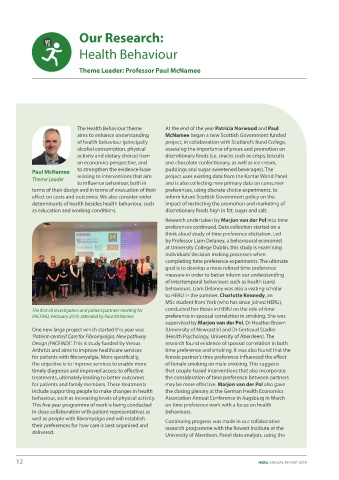
            The first all investigators and patient partners meeting for   conducted her thesis in HERU on the role of time
            PACFIND, February 2019, attended by Paul McNamee  preference in spousal correlation in smoking. She was
                                                           supervised by Marjon van der Pol, Dr Heather Brown
            One new large project which started this year was   (University of Newcastle) and Dr Gertraud Stadler
            ‘Patient-centred Care for Fibromyalgia: New pathway   (Health Psychology, University of Aberdeen). The
            Design (PACFIND)’. This is study funded by Versus   research found evidence of spousal correlation in both
            Arthritis and aims to improve healthcare services   time preference and smoking. It was also found that the
            for patients with fibromyalgia. More specifically,   female partner’s time preference influenced the effect
            the objective is to improve services to enable more   of female smoking on male smoking. This suggests
            timely diagnosis and improved access to effective   that couple-based interventions that also incorporate
            treatments, ultimately leading to better outcomes   the consideration of time preference between partners
            for patients and family members. These treatments   may be more effective. Marjon van der Pol also gave
            include supporting people to make changes in health   the closing plenary at the German Health Economics
            behaviour, such as increasing levels of physical activity.   Association Annual Conference in Augsburg in March
            This five year programme of work is being conducted   on time preference work with a focus on health
            in close collaboration with patient representatives as   behaviours.
            well as people with fibromyalgia and will establish
                                                           Continuing progress was made in our collaborative
            their preferences for how care is best organised and
                                                           research programme with the Rowett Institute at the
            delivered.
                                                           University of Aberdeen. Panel data analysis, using the


       12                                                                                   HERU ANNUAL REPORT 2019

