


Page 14 - A9Rc19d2z_zddyc4_fc0.tmp
P. 14
Our Research:


                             Assessment of Technologies


                             Theme Leader: Dr Graham Scotland


                              The Assessment of Technologies   Technology Management
                              (AoT) theme aims to apply and
                                                           Researchers in the AoT theme are involved in two
                              develop economic evaluation
                                                           new randomised controlled trials funded by the
                              methods to support decision
                                                           NIHR: the ‘REGAL’ study – ‘Recurrence of endometriosis:
                              making across the life course
                                                           GnRH analogues versus laparoscopic surgery trial’ – will
                              of health technologies
                                                           evaluate the clinical and cost-effectiveness of long-
            Graham Scotland   (Technology Management).     term use of GnRH agonists with add-back hormone
                              Our applied economic
            Theme Leader                                   replacement therapy as an alternative treatment
                              evaluations are based on a
                                                           to further laparoscopic surgery for women with
            combination of evidence synthesis and decision
                                                           recurrent endometriosis; the ‘SCRIPT’ study – ‘Selective
            modelling, and analysis of individual patient data
                                                           Caries Removal in Permanent Teeth’ – aims to assess
            collected alongside randomised controlled trials
                                                           the clinical and cost-effectiveness of selective caries
            or observational studies. The research theme also
                                                           removal with complete caries removal in permanent
            recognises the policy emphasis in Scotland and
                                                           posterior teeth.
            internationally on person-centred care. We reflect
            this in our sub-theme of research which focuses on
            ‘Broader measurement of value in economic evaluation’.
               Recurrence of endometriosis: GnRH
               analogues versus laparoscopic surgery
               trial (REGAL)
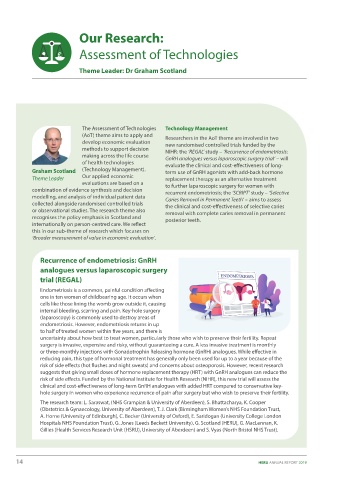
               Endometriosis is a common, painful condition affecting
               one in ten women of childbearing age. It occurs when
               cells like those lining the womb grow outside it, causing
               internal bleeding, scarring and pain. Key-hole surgery
               (laparoscopy) is commonly used to destroy areas of
               endometriosis. However, endometriosis returns in up
               to half of treated women within five years, and there is
               uncertainty about how best to treat women, particularly those who wish to preserve their fertility. Repeat
               surgery is invasive, expensive and risky, without guaranteeing a cure. A less invasive treatment is monthly
               or three-monthly injections with Gonadotrophin Releasing hormone (GnRH) analogues. While effective in
               reducing pain, this type of hormonal treatment has generally only been used for up to a year because of the
               risk of side effects (hot flushes and night sweats) and concerns about osteoporosis. However, recent research
               suggests that giving small doses of hormone replacement therapy (HRT) with GnRH analogues can reduce the
               risk of side effects. Funded by the National Institute for Health Research (NIHR), this new trial will assess the
               clinical and cost-effectiveness of long-term GnRH analogues with added HRT compared to conservative key-
               hole surgery in women who experience recurrence of pain after surgery but who wish to preserve their fertility.
               The research team: L. Saraswat, (NHS Grampian & University of Aberdeen), S. Bhattacharya, K. Cooper
               (Obstetrics & Gynaecology, University of Aberdeen), T. J. Clark (Birmingham Women’s NHS Foundation Trust,
               A. Horne (University of Edinburgh), C. Becker (University of Oxford), E. Saridogan (University College London
               Hospitals NHS Foundation Trust), G. Jones (Leeds Beckett University), G. Scotland (HERU), G. MacLennan, K.
               Gillies (Health Services Research Unit (HSRU), University of Aberdeen) and S. Vyas (North Bristol NHS Trust).


       14                                                                                   HERU ANNUAL REPORT 2019

