


Page 18 - A9Rc19d2z_zddyc4_fc0.tmp
P. 18
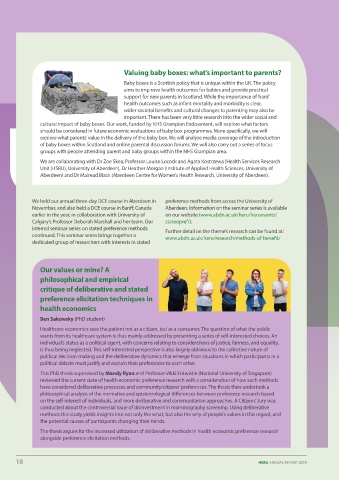
Valuing baby boxes: what’s important to parents?

                                             Baby boxes is a Scottish policy that is unique within the UK. The policy
                                             aims to imp rove health outcomes for babies and provide practical
                                             support for new parents in Scotland. While the importance of ‘hard’
                                             health outcomes such as infant mortality and morbidity is clear,
                                             wider societal benefits and cultural changes to parenting may also be
                                             important. There has been very little research into the wider social and
               cultural impact of baby boxes. Our work, funded by NHS Grampian Endowment, will explore what factors
               should be considered in future economic evaluations of baby box programmes. More specifically, we will
               explore what parents’ value in the delivery of the baby box. We will analyse media coverage of the introduction
               of baby boxes within Scotland and online parental discussion forums. We will also carry out a series of focus
               groups with people attending parent and baby groups within the NHS Grampian area.
               We are collaborating with Dr Zoe Skea, Professor Louise Locock and Agata Kostrzewa (Health Services Research
               Unit (HSRU), University of Aberdeen), Dr Heather Morgan (Institute of Applied Health Sciences, University of
               Aberdeen) and Dr Mairead Black (Aberdeen Centre for Women’s Health Research, University of Aberdeen).


            We held our annual three-day DCE course in Aberdeen in   preference methods from across the University of
            November, and also held a DCE course in Banff, Canada   Aberdeen. Information on the seminar series is available
            earlier in the year, in collaboration with University of   on our website (www.abdn.ac.uk/heru/heruevents/
            Calgary’s Professor Deborah Marshall and her team. Our   statedpref/).
            internal seminar series on stated preference methods
                                                           Further detail on the theme’s research can be found at:
            continued. This seminar series brings together a
                                                           www.abdn.ac.uk/heru/research/methods-of-benefit/
            dedicated group of researchers with interests in stated


               Our values or mine? A

               philosophical and empirical
               critique of deliberative and stated
               preference elicitation techniques in
               health economics

               Ben Sakowsky (PhD student)
               Healthcare economics sees the patient not as a citizen, but as a consumer. The question of what the public
               wants from its healthcare system is thus mainly addressed by presenting a series of self-interested choices. An
               individual’s status as a political agent, with concerns relating to considerations of justice, fairness, and equality,
               is thus being neglected. This self-interested perspective is also largely oblivious to the collective nature of
               political decision-making and the deliberative dynamics that emerge from situations in which participants in a
               political debate must justify and explain their preferences to each other.
               This PhD thesis supervised by Mandy Ryan and Professor Vikki Entwistle (National University of Singapore)
               reviewed the current state of health economic preference research with a consideration of how such methods
               have considered deliberative processes and community/citizens’ preferences. The thesis then undertook a
               philosophical analysis of the normative and epistemological differences between preference research based
               on the self-interest of individuals, and more deliberative and communitarian approaches. A Citizens’ Jury was
               conducted about the controversial issue of disinvestment in mammography screening. Using deliberative
               methods this study yields insights into not only the what, but also the why of people’s values in this regard, and
               the potential causes of participants changing their minds.
               The thesis argues for the increased utilization of deliberative methods in health economic preference research
               alongside preference elicitation methods.


       18                                                                                   HERU ANNUAL REPORT 2019

